
Last updated November 16, 2026
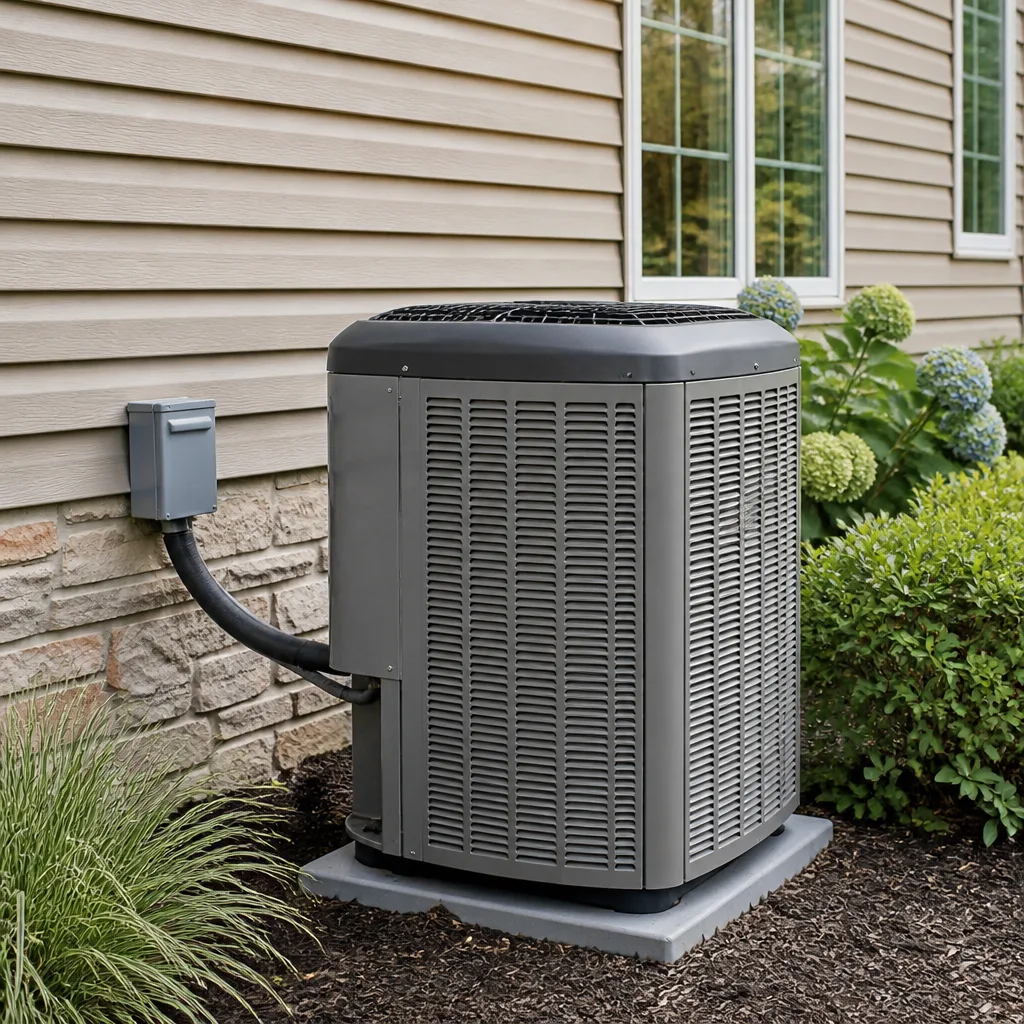 AC repair
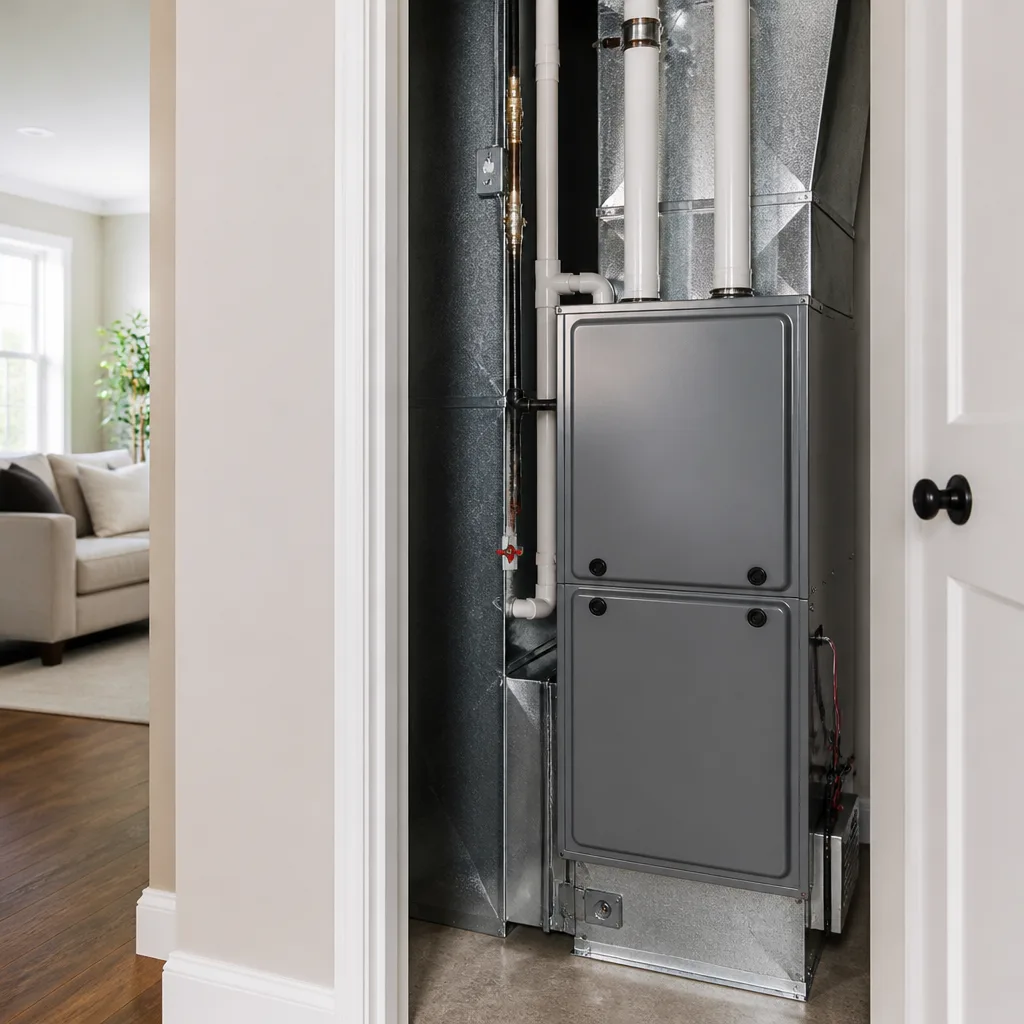 Furnace & heating
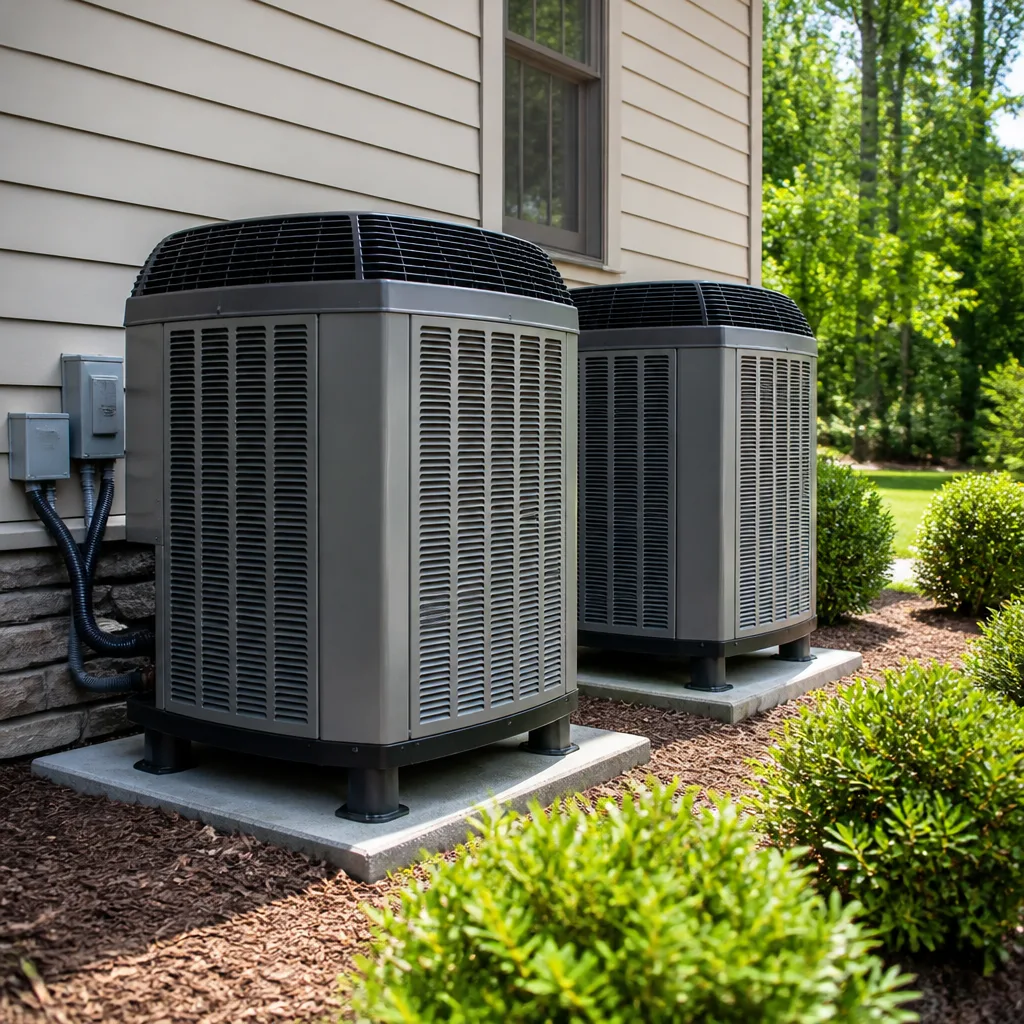 Heat pumps
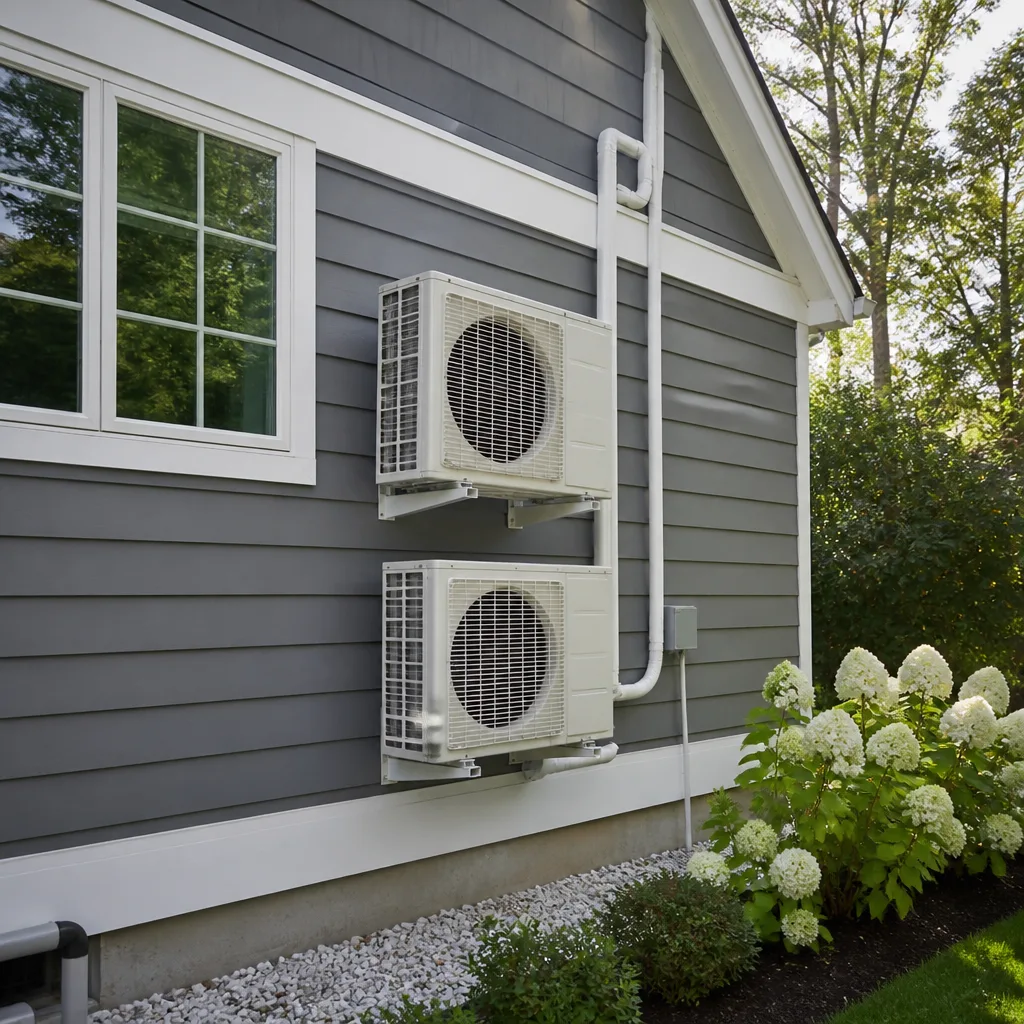 Ductless mini splits
 Carrier
 Trane
 Goodman
Seasonal tune-up and full diagnostic on your Carrier, Trane, or Goodman system - readings shown to you before any repair is proposed
Diagnosis first, numbers second - you approve the repair price before a single part goes in.
Get your free estimateHVAC Warning Signs: An Allen Homeowner’s Reference Guide
A system that short-cycles on a 105°F Allen afternoon and one that short-cycles on a mild 72°F spring morning are telling you two different stories. One is often just a control quirk or a slightly low charge. The other, in Collin County summer heat, can point to a compressor struggling against pressures it wasn’t built to handle, and that’s an entirely different kind of call. Treating every symptom the same way is how homeowners end up either paying for a service visit they didn’t need or waiting out a failure they could have caught. This guide separates the warning signs that mean “note it and watch it” from the ones that mean “call today,” and it explains how Allen’s climate shifts which is which.
Quick Answer
HVAC warning signs fall into two groups: low-urgency indicators like gradual efficiency loss, mild uneven cooling, or a slightly louder blower that you can monitor and schedule around, and same-day indicators like a refrigerant leak (ice on the line set, hissing), a cracked heat exchanger (that rotten-egg or formaldehyde smell with a gas furnace running), burning odors, or repeated short-cycling in extreme heat. In Allen, the same behavior that’s harmless at 80°F outdoor temperature becomes a real failure signal at 100°F and above. When in doubt, call (855) 752-3431 for a free estimate. We answer 24/7. Fast dispatch from 7am to 7pm, Sunday through Friday.
Styles & brands we work with
- AC repair
- Furnace & heating
- Heat pumps
- Ductless mini splits
- Carrier
- Trane
- Goodman
Table of Contents
- The Symptom-to-Diagnosis Matrix: What Each Sign Actually Means
- How Allen’s Summer Heat Load Changes Symptom Interpretation
- Three Warning Signs Allen Homeowners Most Often Dismiss
- Decoding Sounds: What Each Noise Tells You Mechanically
- Decoding Smells and Airflow: What Odors and Weak Flow Indicate
- When to Call Immediately vs. When to Monitor
- Why Brand Familiarity Changes the Diagnosis
- Seasonal Watch Points for Heating and Cooling
The Symptom-to-Diagnosis Matrix: What Each Sign Actually Means
Most symptom charts flatten everything into a single list, which is why homeowners either panic at a harmless click or shrug off a genuine emergency. A better approach sorts each warning sign by urgency tier, probable cause, and what it typically portends. Here is the framework we use when we’re diagnosing equipment in Allen.
Tier 1: Monitor and schedule. These signals suggest wear or gradual degradation. They don’t usually escalate into failure this week, but left alone they raise energy bills and shorten component life.
- Gradual efficiency loss: the same setpoint feels slightly less cool than it did last year. Often a marginally dirty coil or filters overdue for a change.
- Mildly uneven cooling room to room. Could be duct balancing, a partially closed damper, or a system reaching the end of its useful tuning.
- Blower slightly louder than before. Motor bearings or a loose panel. Worth a look, not worth a weekend emergency.
- Occasional water drip at the condensate line. Usually a clogged drain, common in the humid stretches of a North Texas summer.
Tier 2: Same-day service. These signals mean the system is either already failing or heading there fast, and the cost of waiting climbs quickly.
- Ice on the refrigerant line set or evaporator coil. This usually points to low refrigerant, which means a leak.
- A gurgling or hissing sound at the line set. Refrigerant escaping.
- Short-cycling repeatedly in high heat. Compressor or control failure.
- Burning smells with a running system. Electrical fault.
- Rotten-egg or chemical smells with a gas furnace running. Possible heat exchanger crack or combustion issue. Get out and call.
Highpoint AC Repair works both sides of your comfort system, so when a symptom points to the furnace instead of the AC, or to the indoor air handler instead of the condenser, one call covers heating and cooling rather than two contractors.
How Allen’s Summer Heat Load Changes Symptom Interpretation
This is the part that most warning-sign guides don’t address, and it’s the part that matters most for Allen homeowners. Collin County summers routinely push above 100°F, and a system that behaves one way at moderate outdoor temperatures will behave very differently under sustained extreme heat. The symptom doesn’t change; the meaning of the symptom does.
Here’s the mechanism. An air conditioner has a design-day capacity matched to the load of the house it’s cooling. On an 80°F day, an AC will cycle comfortably, keep the house at 74°F, and look perfectly normal even when its charge is low or its coil is dirty. Push outdoor temperature to 100°F or higher, and that same system now runs continuously, works harder to hit the same setpoint, and its marginal deficiencies become visible. A unit that was “cooling fine” in May can start short-cycling in July not because something fundamentally broke, but because the load finally exceeded the reduced capacity.
What this means for symptom interpretation:
- Short-cycling at 80°F outdoor temp: note it, schedule a look. Often a control or charge issue that’s contained.
- Short-cycling at 100°F+ outdoor temp: treat as Tier 2. In extreme heat, short-cycling can mean the compressor is tripping on thermal overload and repeated tripping accelerates failure.
- Weak cooling on a mild day: monitor. Could be blower speed or duct issue.
- Weak cooling on a 105°F afternoon: same-day. A system that can’t keep up under design load may be undercharged, overcharged, or blocked, and any of those is meat on the compressor over time.
- An hour-long recovery after the sun goes down: normal-ish on the hottest days. All-day drip at 80°F ambient: not normal, worth diagnosing.
Our area sees enough sustained triple-digit stretches that the “monitor” line shifts earlier here than it would in a milder climate. A condition that would be a Tier 1 sign in a place where summer tops out at 85°F is Tier 2 in Allen. If you want to understand how installation choices account for our design load, our AC installation page covers load calculation and proper sizing.
Three Warning Signs Allen Homeowners Most Often Dismiss
In the thousands of diagnostic visits we’ve done in North Texas, three symptoms come up again and again as the ones homeowners wrote off as “probably fine” right up until the system failed. Each of these reliably precedes a major repair or replacement within one season, and each is easy to catch early.
- The system can’t hold setpoint on the hottest days, but recovers overnight. Homeowners rationalize this as “it’s just really hot out, of course it struggles.” But a properly sized system in Allen is designed to hold setpoint at design temperature. Failing to do so means the system has lost capacity, usually through low refrigerant, a dirty coil, or a blower running below spec. Left alone, each of those damages the compressor over the course of a summer, and what would’ve been a modest repair becomes a replacement.
- A slow but consistent rise in the electric bill. Homeowners sometimes attribute this to utility rate changes and never look at the equipment. Gradual efficiency decline is one of the earliest signals of a system heading downhill, and it’s usually visible in the bill months before an obvious breakdown.
- A rhythmic rattle or click at startup that wasn’t there a year ago. Often dismissed as “found its voice.” Mechanical noise that’s new is rarely harmless in HVAC. Startup rattle frequently indicates a failing contactor, capacitor, or loose panel vibration. Each is modest to fix early and expensive to fix after the downstream damage lands.
The pattern here is that all three signs are gradual. None of them trigger an obvious “call now” instinct, which is exactly why they get ignored. Catching any of these early gives you the option to schedule rather than react. If the equipment is gas-fired, the same early attention applies on the heating side, and our furnace repair page covers what needs immediate attention versus what can be scheduled.
Decoding Sounds: What Each Noise Tells You Mechanically
Sound is one of the most information-rich diagnostic signals an HVAC system gives off, and it’s also the most overlooked. Here’s what each type of noise usually indicates mechanically, along with the tier it belongs in.
- Banging at startup. Loose panel, blower getting ready to fail, or something contacting the fan. Tier 1 unless accompanied by a burning smell, in which case Tier 2.
- Clanking that repeats on a cycle. Something contacting the fan blades or the compressor internals. Tier 2.
- Hissing at the refrigerant lines. Refrigerant escaping. Tier 2, same-day.
- Gurgling in the line set. Refrigerant moving as a mix of liquid and gas. Usually low charge. Tier 2.
- Squealing at startup. Failing blower belt (older systems) or a blower motor bearing. Tier 1 if intermittent, Tier 2 if constant.
- Buzzing at the outdoor unit that wasn’t there before. Contactor or capacitor chatter. Tier 2 if the unit is failing to start.
- Clicking that repeats every few minutes with the system running. Short-cycling. Urgency depends on outdoor temperature, per the heat-load section above.
- Rattling that intensifies with fan speed. Loose panel, failing motor mount, or debris in the cabinet. Tier 1.
One rule covers nearly all of them: new noise is different from old noise. The low hum your condenser made last summer that it still makes is baseline. A rattle that showed up in June and has gotten worse by August is a signal. If the noise is loud enough that you want to turn the system off, that’s the answer to the urgency question.
Decoding Smells and Airflow: What Odors and Weak Flow Indicate
Smell is where the stakes rise fastest. Some odors are harmless and some are a genuine safety concern, and the difference isn’t obvious without knowing what each one means. Airflow tells a parallel story about what’s happening in the ductwork and at the coil.
Odors and what they indicate
- Musty, damp smell when the AC runs. Microbial growth on the evaporator coil or in the drain pan. Usually Tier 1 but worth addressing before it spreads. Common in the humid months because the drain line often clogs.
- Electrical or burning smell with the system running. Tier 2, immediate. This means wiring, contactor, or motor insulation is overheating somewhere. Turn the system off at the thermostat and call.
- Rotten-egg smell with a gas furnace running. Possible heat exchanger crack or combustion problem leaking carbon monoxide. Get everyone out of the house and call from outside. This is a genuine safety emergency and not a symptom to monitor.
- Formaldehyde or chemical smell near the furnace. Same concern as above.
- Dirty-sock smell throughout the house. Often a duct or indoor coil issue. Tier 1, but if the smell is persistent, ask about duct condition when you schedule.
If you smell gas – whether or not the furnace is running – leave the house and call your gas utility first. That’s a non-negotiable step.
Airflow and what it indicates
- Weak airflow at some vents but strong at others. Duct balancing or a partially disconnected run. Tier 1.
- Weak airflow at every vent. Blower issue, filter overload, or return-side restriction. Tier 1 to 2 depending on severity.
- Airflow weaker than it was last season. Often a clogged evaporator coil or a blower losing efficiency. Tier 1.
- Airflow that’s fine but not cool. Different problem. That’s a cooling capacity issue, not an airflow issue, and it usually lives on the refrigerant side.
When to Call Immediately vs. When to Monitor
This is the decision framework that prevents both unnecessary service calls and the far more expensive mistake of ignoring a genuine failure indicator. It comes down to four questions.
- Is there any safety concern? Gas smell, burning smell, visible smoke, or an electrical smell means call immediately. Safety always overrides every other consideration.
- Is the system failing to keep up during sustained heat? If outdoor temps are above 100°F and the system can’t hold within a couple of degrees of setpoint through the afternoon, treat as same-day. On a milder day, monitor and schedule.
- Is there ice, hissing, or fluid on the refrigerant side? Any of those is a leak signal. Same-day.
- Is it noisy, drippy, or inefficient but still running? Monitor and schedule. Something is degrading, but nothing is about to fail dangerously.
A fifth question worth adding if you’re weighing repair against replacement: how old is the equipment, and has it had prior major repairs? Equipment hitting the 12-year mark with a repeat issue usually tips toward replacement over another repair. That’s not a universal rule, but it’s the honest framing.
One practical point on the call itself: our phones are answered 24/7. If the call comes outside dispatch hours, we book it into the next opening, Sunday through Friday, 7am to 7pm. You won’t be waiting until Monday to hear back from someone on Saturday, because Saturday is our closed day for dispatch.
Why Brand Familiarity Changes the Diagnosis
Symptoms that sound identical can stem from very different root causes depending on manufacturer. A Goodman system short-cycling has a different list of likely causes than a Rheem or a York, because each manufacturer designs its control boards, defrost logic, and component clearances differently. A technician who already knows your brand walks in with a shorter diagnostic path than one who has to look up the sequence of operations on the fly.
We’re certified to work on nine major HVAC brands: Carrier, Trane, Lennox, Goodman, Rheem, York, Daikin, Bryant, and American Standard. That matters when we’re reading symptoms in Allen homes because the fault codes, the failure patterns, and the expected component life all vary across those lines. A Cross-brand diagnostic knowledge isn’t a nice-to-have; it’s what turns a “no cool” call into a defined fix inside one visit.
Our technicians have up to 11 years of experience across those manufacturer lines. When we say we’re already familiar with your system, it means we’ve seen its failure modes before, not just its nameplate.
Seasonal Watch Points for Heating and Cooling
Symptoms cluster by season, and knowing what to watch for on each side of the year makes the monitoring habit much easier. Here’s the breakdown for Allen’s climate.
Warm-season watch points (cooling)
- Filter condition every 30 to 90 days depending on pet hair and dust. A clogged filter is the single most common trigger behind weak airflow and frozen coils.
- Condensate drain line. In humid stretches, drains clog faster. A cup of standing water in the pan is a signal.
- Outdoor unit clearance. Two feet of clear space around the condenser is the general rule, and it matters more in high-heat months.
- Listen for the first short-cycle of the season. The first hot week is when the compressor mechanics get tested after a mild break.
Cool-season watch points (heating)
- Furnace ignition sound. A clean light-off is quiet. Delayed ignition or repeated click attempts suggests a component problem worth diagnosing.
- Flame color. A steady blue flame is normal. A yellow or orange flame with the burner running is a reason to call.
- Combustion air intake. Blockage around the intake plus a tight house can cause incomplete combustion.
- First heat-call smell. A slight dusty smell on the first heat of the season is normal from sitting. A persistent chemical or rotten-egg smell is not.
Homeowners in Allen get the most out of a single annual inspection on each side of the system, timed before the season kicks in. The inspection catches gradual issues before the heat or cold tests them. For a full replacement, the right time to plan is before the equipment fails, not after. Our Allen location page covers how our coverage works for the surrounding neighborhoods and what scheduling looks like across the area.
Common Mistakes to Avoid
- Treating every symptom the same. A Tier 1 rattle and a Tier 2 hissing refrigerant line don’t belong in the same response plan, and treating them identically either wastes your time or delays needed repair.
- Assuming extreme-heat struggle is normal. It isn’t, in properly sized equipment. If the system can’t hold setpoint at 100°F+, that’s information, not a fact of Texas life.
- Waiting for the system to fail before scheduling anything. Gradual symptoms become sudden failures, and the transition always happens on a busy weekday or a Saturday when dispatch is booked.
- Replacing filters on the calendar instead of on condition. A home with pets may need a filter change every 30 days through summer. A low-pet home may go 90. Follow the filter, not the calendar.
- Ignoring the bill. A steady rise in summer electric draw without a rate increase is the earliest signal of a system losing efficiency.
- Running the system with a suspected refrigerant leak. Ice on the line set plus continued operation is how a compressor fails, and that turns a moderate repair into a replacement.
- Calling replacement when the equipment just needs a proper diagnosis. The reverse mistake is just as real. A system under 10 years old with one heating-side issue rarely needs a full replacement, no matter how persuasive the voice on the other end of the phone.
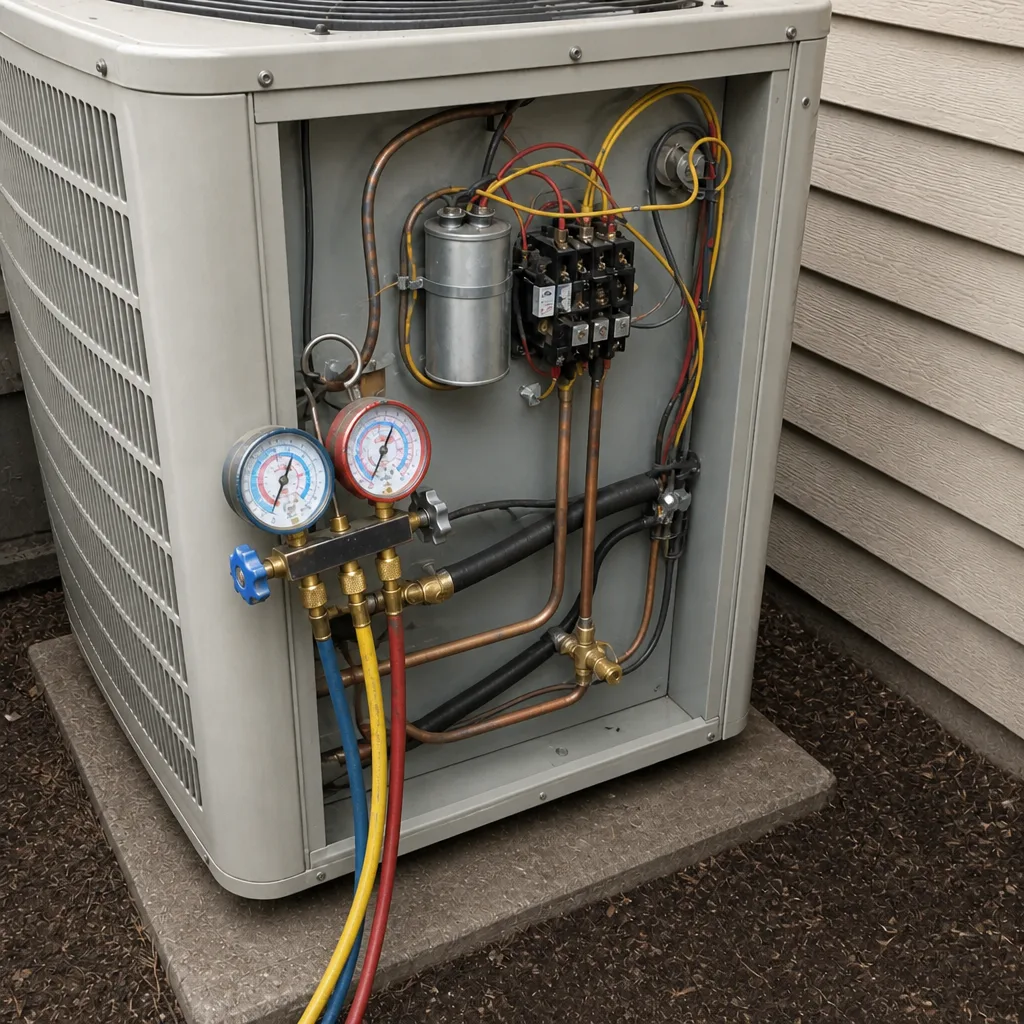
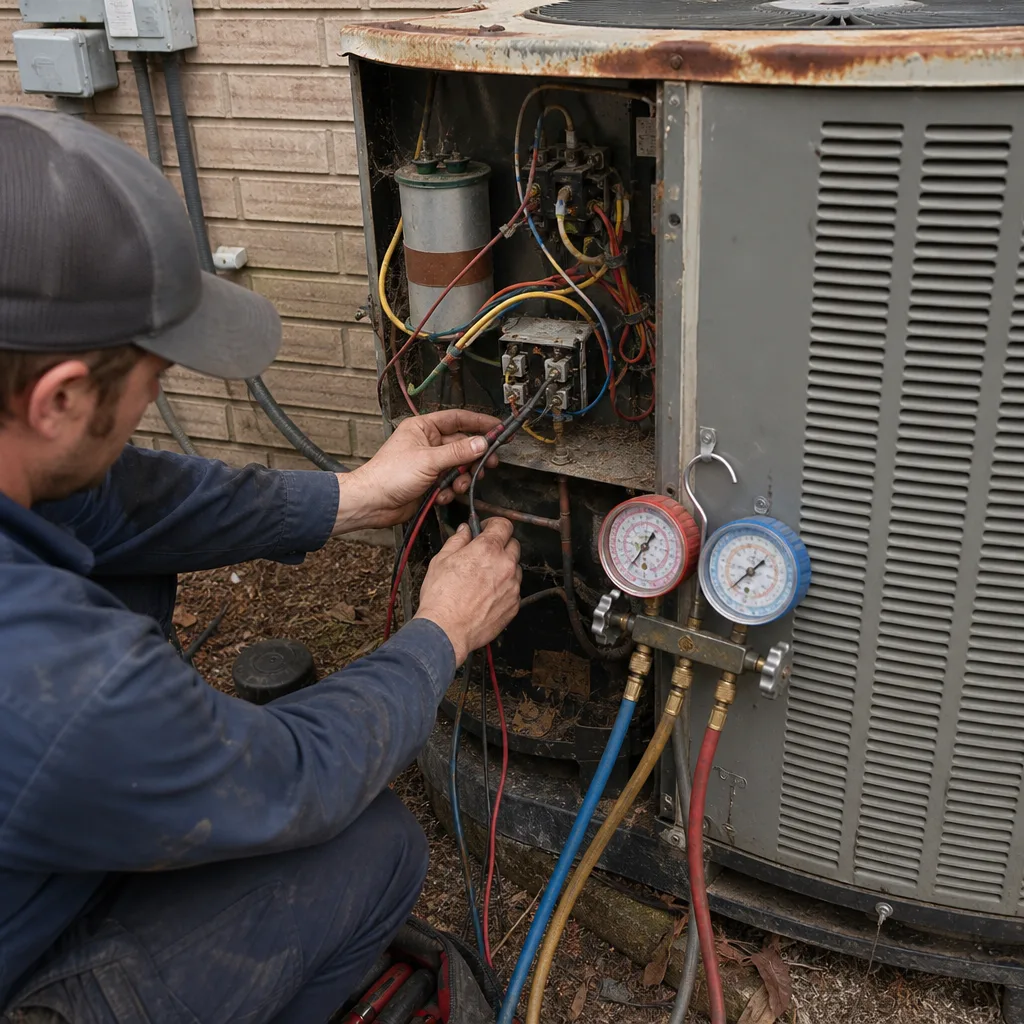
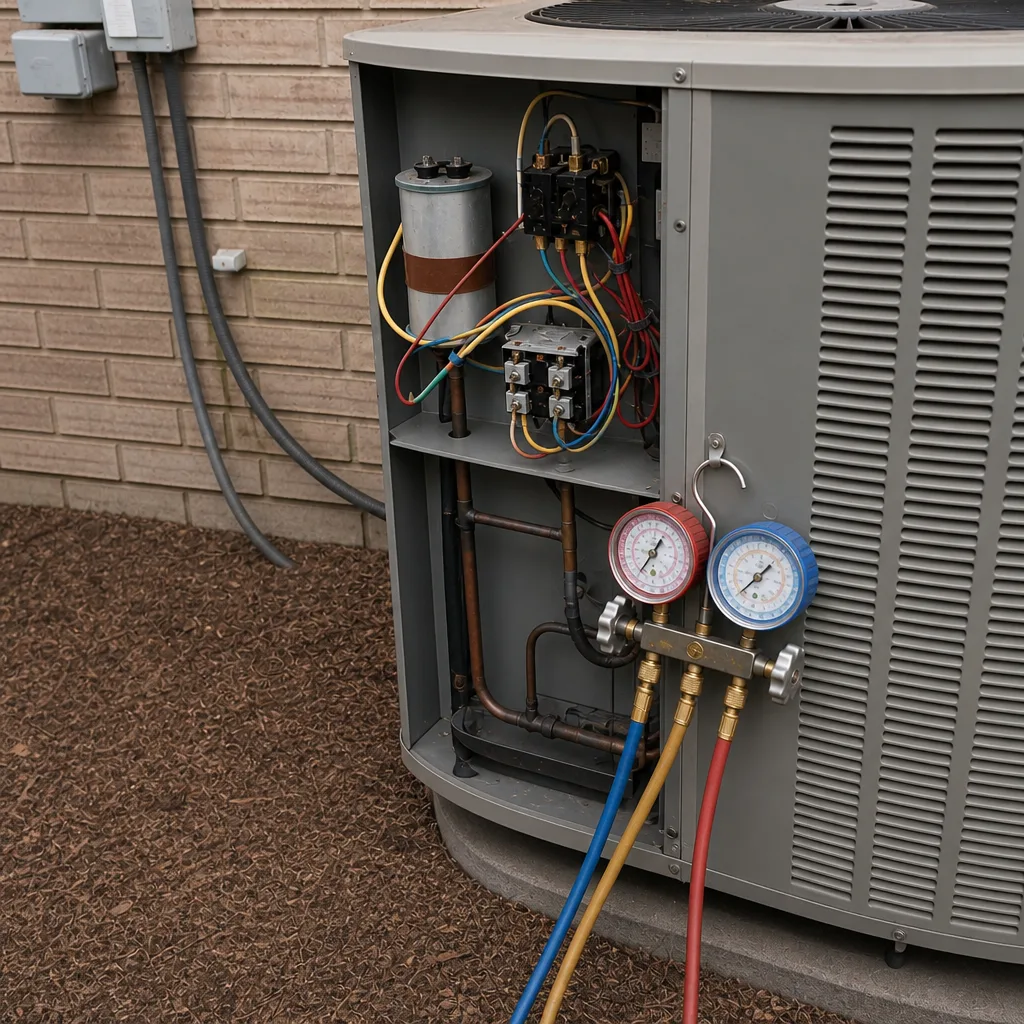
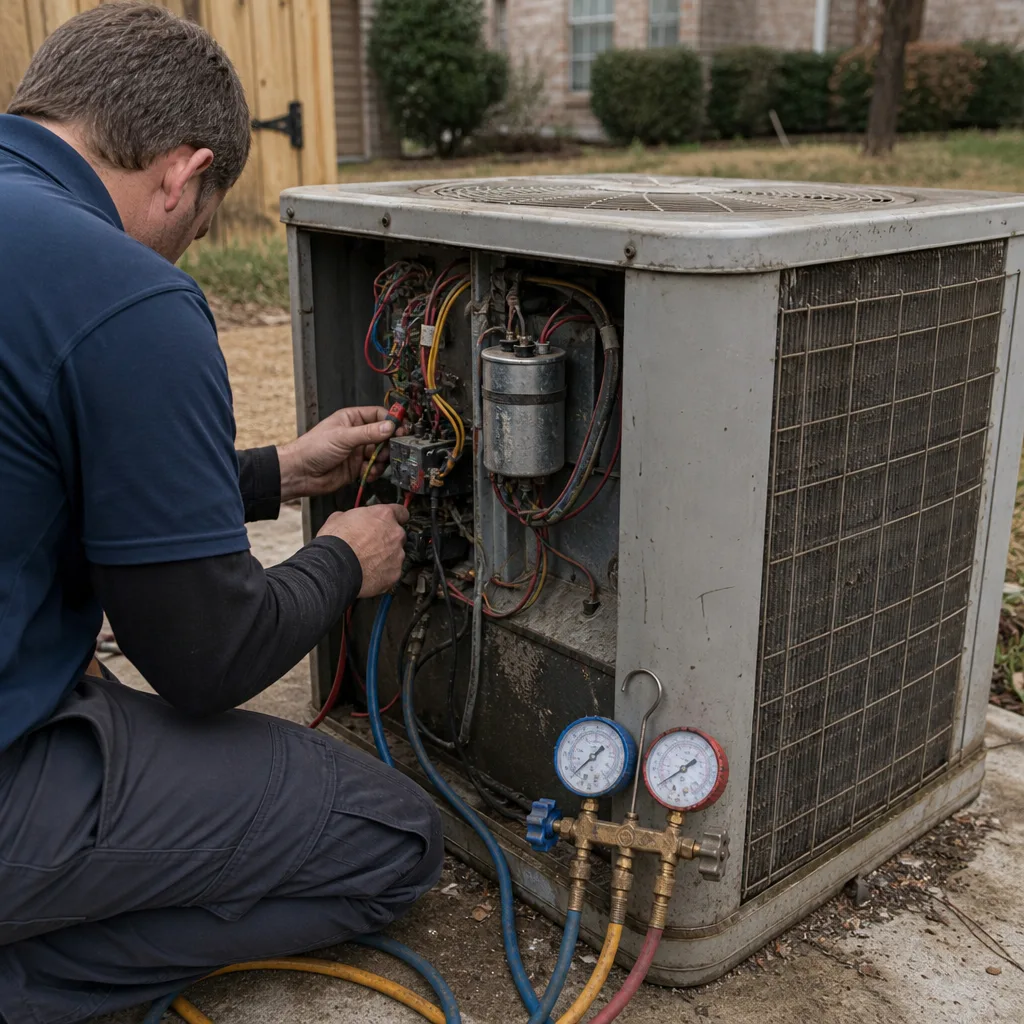
See the difference
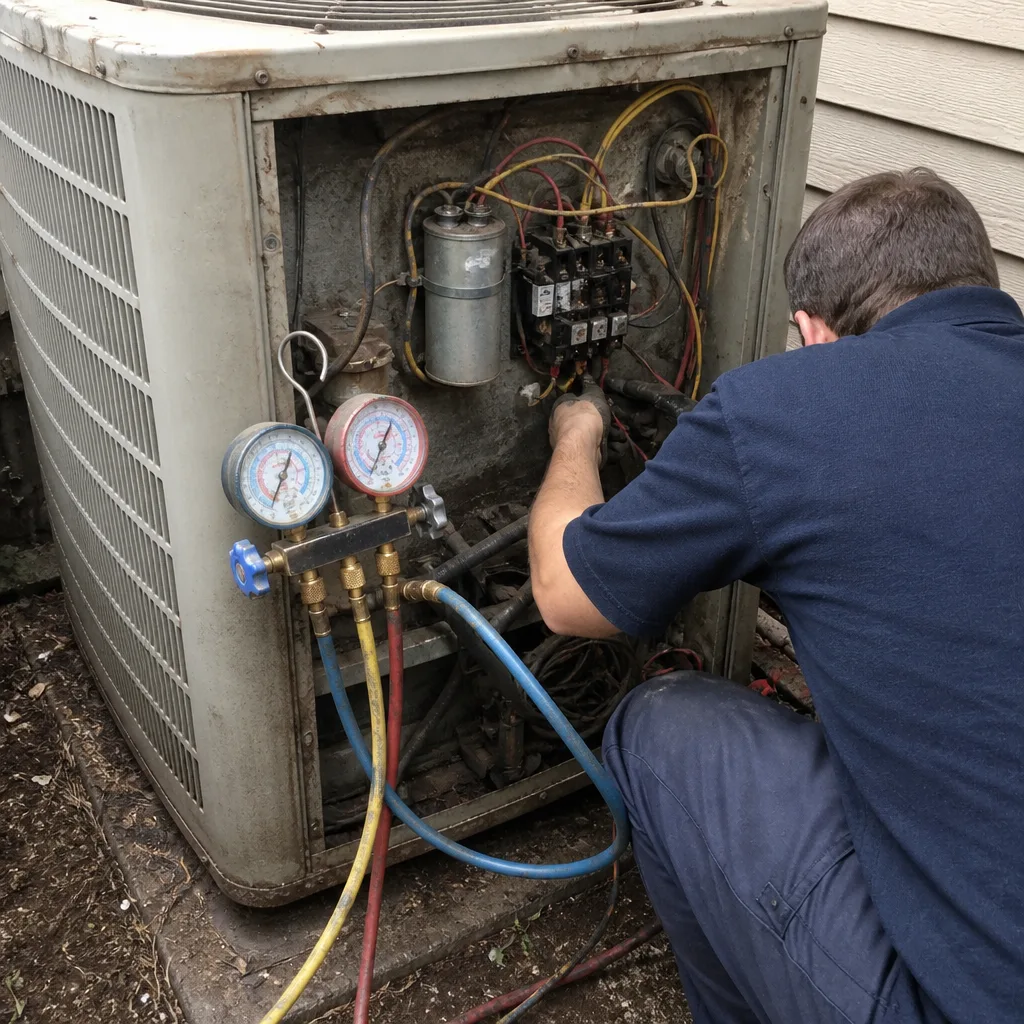 Before
 After
 Before
 After
 Before
 After
When to Call a Professional
Call us for any of these: a suspected refrigerant leak (ice on the lines, hissing, gurgling), any burning or electrical smell with the system running, any gas smell or chemical smell near a running furnace, repeated short-cycling in high heat, or an unexplained rise in your electric bill with no setpoint change. Also call if the system can’t hold setpoint on 100°F+ afternoons, or if the blower produces heat on the cooling setting or cool air on the heat setting. Highpoint AC Repair offers free estimates in Allen. Call (855) 752-3431. We answer 24/7. Fast dispatch from 7am to 7pm, Sunday through Friday. The written estimate sets the price; there’s no diagnostic fee on top. Our technicians have up to 11 years of experience, and we work both furnace repair and cooling calls under one roof, so a single call covers the whole system.
Frequently Asked Questions
No. Short-cycling at moderate outdoor temperatures is often a control or charge issue that’s contained and can be scheduled. Short-cycling at 100°F+ is a different story: in extreme heat, short-cycling frequently means the compressor is tripping on thermal overload, and repeated tripping accelerates failure. If it’s happening on the hottest days, treat it as a same-day call. Call (855) 752-3431 for an exact quote – estimates are free.
A refrigerant leak usually shows as ice on the line set (the insulated pipe running from the indoor unit to the outdoor condenser), a gurgling sound, or a hissing sound. Normal refrigerant flow is quiet. Any persistent hiss or visible ice on those lines is a signal to call rather than monitor. Turn the system off if ice is present and call (855) 752-3431 – estimates are free.
It can be. A burning or electrical smell with the system running usually points to overheating wiring, a failing contactor, or motor insulation breaking down. Turn the system off at the thermostat and call. Do not continue running the equipment to “see if it goes away.” Call (855) 752-3431 – we answer 24/7. Fast dispatch from 7am to 7pm, Sunday through Friday.
Not always, and we don’t offer duct cleaning as a service. A musty smell usually points to microbial growth on the evaporator coil or standing water in the drain pan, both of which we can diagnose. If the smell persists after the drain and coil are checked, ask about duct condition when you call. Call (855) 752-3431 – estimates are free.
It depends on the specific symptom and the history of repairs. A 12-year-old system with one gradual issue is often worth a repair, provided the diagnosis confirms the underlying component is fixable and the refrigerant circuit is sound. If there’s a refrigerant leak or a compressor issue on equipment that age, replacement often makes more sense than a second repair. Call (855) 752-3431 for an honest read – estimates are free.
Pricing depends on the size and configuration of the home and the equipment you choose, and the written estimate sets the price. We handle new AC installation and furnace replacement ourselves rather than handing off, and we work with the nine major brands we’re certified on. We don’t promise same-day replacement, because the work is load-calculated and scheduled – what we promise is a set install date and a written fixed price. Call (855) 752-3431 for a free estimate.
The Bottom Line
Warning signs don’t all point to the same urgency, and treating them as one list is the mistake that either costs you a service call you didn’t need or a failure you could have avoided. Sort symptoms into two groups: monitor-and-schedule (gradual efficiency loss, mild airflow issues, low rattle) versus same-day (refrigerant leak, burning or gas smells, short-cycling in extreme heat). Then adjust the line based on Allen’s heat load: at 100°F+, symptoms that would be mild on a spring morning become real indicators of trouble. Catch the three most-dismissed signs early – setpoint struggle in heat, slowly rising bills, new startup noise – and you keep the choice of scheduling replacement on your terms. When in doubt, call.
Highpoint AC Repair installs new systems, replaces furnaces, and repairs furnaces – one call covers heating and cooling across the brands we’re certified on. We’re at (855) 752-3431 with free estimates. We answer 24/7. Fast dispatch from 7am to 7pm, Sunday through Friday. Our technicians have up to 11 years of experience, and they’re already familiar with your equipment before they arrive.
Written by the team at Highpoint AC Repair.